
Commercial banks in the country continued with their improving asset quality trend in the October-December 2021 quarter with slippages remaining under control coupled with healthy recoveries and upgradation of asset classification. The 28-listed banks reported improvement in bottom line with net profits rising 64.1 per cent year-on-year (YoY) and 21.5 per cent sequentially. This is mostly on account of a fall in provisions and contingencies.

'We have seen something do very well when the times are good but maybe not as well when the times are bad.'

If they are made accountable, bad loan cases will shrink dramatically, recoveries will rise, and the NCLT process will be more manageable, asserts Debashis Basu.

'Expect India to keep doing well irrespective of geopolitics.'

Believe it or not, the regulator is even stretching its arm to identify stressed borrowers and gauge the 'distance to default' as a measure of a particular bank's fragility, reveals Tamal Bandyopadhyay.

'It was inspired by the Hamas attack and was like their attack -- well planned and well executed.'

'Life does not change in such a way that everything becomes easy. Struggle and hustle is there for everyone. 'The difference is that people have started knowing me.'

The stocks are largely from sectors such as chemicals, finance and cement, which struggled earlier but the worse seems to be behind them.

'Tax rate and stock markets are entirely two different things.'

A paper authored by Rajan said, state-linked banks can be a first step in altering the ownership structure of some PSBs, where the government brings down its stakes to below 50 per cent, creating distance from operations of banks, and improving governance along the way.

The RBI working group's proposal to allow corporate houses to set up banks is a 'good-looking' step in a 'bad direction' and may lead to crony capitalism and eventual financial instability, former chief economist of World Bank Kaushik Basu said on Thursday. Basu further said that there is a good reason why all successful economies have a clear dividing line between industries and corporations on the one hand, and banks and lending organisations on the other.

It was a protest which held a mirror to the government of a state taking pride in its commitment to democracy, gender equality and social indices.One person, who in his employed days had known governments and political parties at close quarters, told me that public perception of how the Kerala government handled the ASHA workers' strike had been terrible, reports Shyam G Menon.

A Rs 525-crore contingency provision during the July-September period led to a 19 per cent fall in IndusInd Bank's share price on Friday (October 25). Contingency provisions are generally made when a lender expects more bad loans in the coming quarters. Shares of the bank on Tuesday (October 29) declined 1.53 per cent to settle at Rs 1,038.2 apiece on the BSE.

Over the medium and long term, the BJP hopes to devour the AIADMK, they having identified the party as 'ideologically not as sound as the DMK', predicts N Sathiya Moorthy.

'The finance minister has done as much as she can when you look into the fiscal constraints she had.'

It won't be easy for the banking sector to better its performance every quarter, predicts Tamal Bandyopadhyay.

Rooted in Tamil Nadu, Mali's love story brought him to South Africa, where he started playing again, though his journey was short-lived.

'They have since only tried to improve systems. Also, with regulatory guidance from time to time, we are in a position to assess a situation and react in time.'

Congress does unto AAP what Kejriwal's party had done to it in Haryana.

From CEOs to RBI governors, cricket's rich imagery and strategy resonate deeply with leadership, uncertainty, and decision-making across industries and global diplomacy, points out Suveen Sinha.

Even as banks and finance companies are reporting record-high earnings, their weighting in the benchmark National Stock Exchange Nifty50 Index has seen a downward trajectory. Investors expect a stronger performance from other sectors in the new year. Currently, banking, financial services and insurance (BFSI) companies collectively hold a weighting of 34.5 per cent, down from 36.7 per cent at the end of December 2022 and a record high of 40.6 per cent at the end of December 2019. This represents the sector's lowest weighting in the index since December 2021 when it stood at 33.7 per cent.

Why did the company zero in on RBL Bank to understand the business of banking? While the M&M investors heaved a sigh of relief, one gentleman must have been all smiles after this, RBL Bank MD and CEO R Subramaniakumar, notes Tamal Bandyopadhyay.

After Sita Raman, this is a Dulquer Salmaan film that has won Divya Nair's heart.

SBI on Friday reported a 23 per cent on-year jump in consolidated net profit at Rs 19,782 crore for the quarter ended September 30, 2024. The consolidated net profit for the corresponding period last year stood at Rs 16,099 crore.

These 10 stocks represent the best mix of value and growth, offering relatively low price-to-earnings and price-to-book ratios, a high return on equity, and sufficiently high potential from current levels.

'Till the BJP does not understand Kejriwal they cannot win Delhi.'

'We suggest an equity strategy of 5% to 10% exposure to cash, 5% to Gold ETF, close to 50% to Sensex/Nifty/large mid-cap stocks.'

Foreign portfolio investors (FPIs) sold shares worth Rs 20,170 crore ($2.4 billion) recently. This marked the fifth-highest weekly outflow from overseas funds since the beginning of 2008 and the largest since the last week of March 2020. Due to the Covid scare, FPIs had sold shares worth Rs 21,951 crore during that week, causing the market to decline by nearly 20 per cent.

Finance Minister Nirmala Sitharaman's Rs 30,600 crore government guarantee for the bad bank has changed the body language of bankers for the better, observes Tamal Bandyopadhyay.

Since the bankcuptcy law came into effect from December 2016, with every quarter, the recovery rate has progressively been going down, notes Tamal Bandyopadhyay.

We the people are left in the wind, waiting on the whims of an unengaged president and an oligarch with a nearly bottomless wallet, observes Sree Sreenivasan.

The upcoming Delhi Assembly elections are set to be a thrilling contest between the ruling Aam Aadmi Party (AAP), the resurgent Bharatiya Janata Party (BJP), and the Congress. The BJP is focusing on its "Parivartan" (change) slogan and a targeted campaign against AAP over corruption allegations, while AAP is highlighting the credibility of its leader, Arvind Kejriwal, and his promises to deliver on his promises. The Congress, seeking to reclaim its lost footing in the national capital, is also campaigning with a renewed vigor.

The national team, captained for the bulk of those years by Misbah Ul Haq, hosted its 'home' games in the United Arab Emirates and remained relatively successful until fixtures trickled back onto Pakistani soil in 2018.

We'll need to wait a couple of years to see how many restructured loans turn bad and whether some banks fall victim to their obsession for growth, explains Tamal Bandyopadhyay.

Shaktikanta Das will demit the office on Tuesday after completing six years as the 25th Governor of the Reserve Bank of India. Revenue Secretary Sanjay Malhotra will replace him as the 26th Governor. He was appointed as the Governor on December 12, 2018, after the abrupt exit of Urjit Patel.
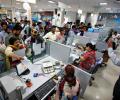
Currently, banks are closed every second and fourth Saturday of a month. Why shouldn't they be shut every Saturday? When most customers carry their banks in their pocket (the app on the mobile phone), there is no need to keep banks open on Saturdays, argues Tamal Bandyopadhyay.
Companies in the banking, finance sector and insurance (BFSI) sector have underperformed on the bourses despite leading the earnings growth charts in the post-pandemic period. This has created a dichotomy between their earnings and share prices. BFSI companies have never been less expensive than the rest of the equity market.

Factors like dedicated recovery teams, centralised follow-up on bad loan accounts and resolutions via NCLT are driving the trend

'By not letting bankrupt banks fail, we have discouraged ordinary folk from taking precautions while choosing their bank or at least when they hear bad news about their bank,'says S Muralidharan, former MD, BNP Paribas.

The crisis in Indian banking has now reached a point where the NPAs of many public-sector banks are higher than their net worth
 © 2026 Rediff.com - Advertise with us - Disclaimer - Privacy Policy - Sitemap - Feedback - About us - Terms of use - Grievances